
Decay spectroscopy of heavy and superheavy nuclei
The search for next shell closures beyond 208Pb, the location of the so-called ‘‘island of stability of superheavy nuclei’’ is still one of the most prominent challenges in nuclear physics. This paper summarizes the progress made for the heaviest nuclides from 𝑍 = 99 (einsteinium) to 𝑍 = 118 (oganesson), comprising a literature review as well as a comprehensive table listing the major properties for each known isotope and isomeric state. An installation with the potential to extend this research substantially is the super separator-spectrometer S3.
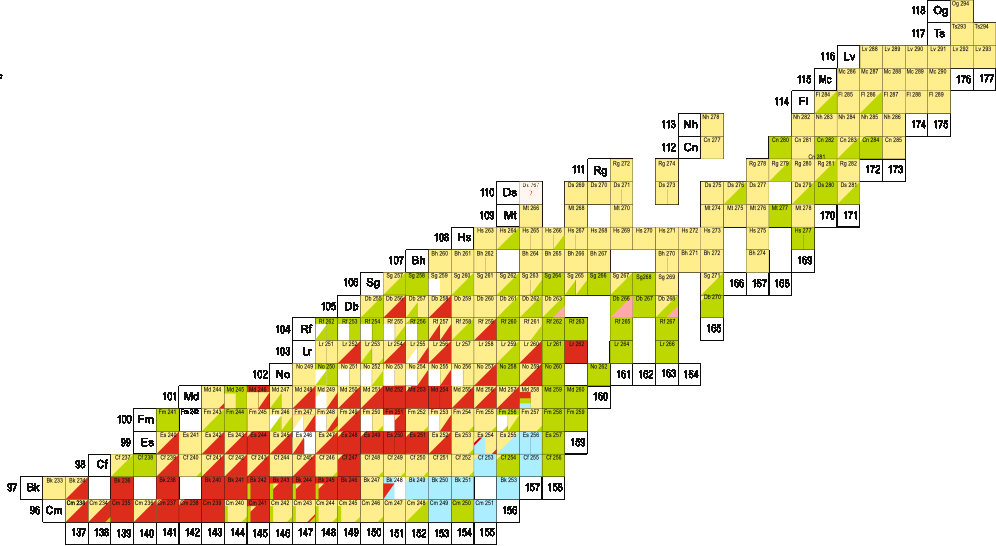
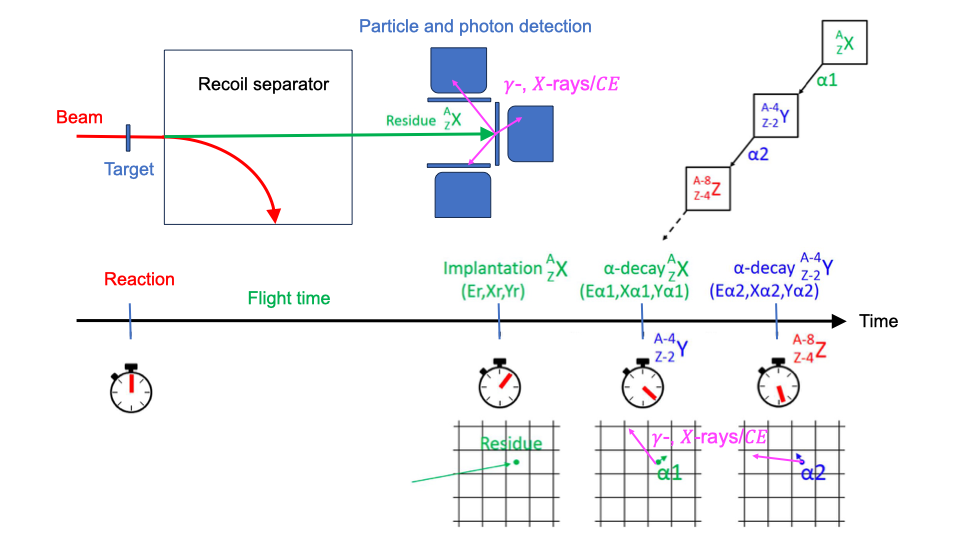
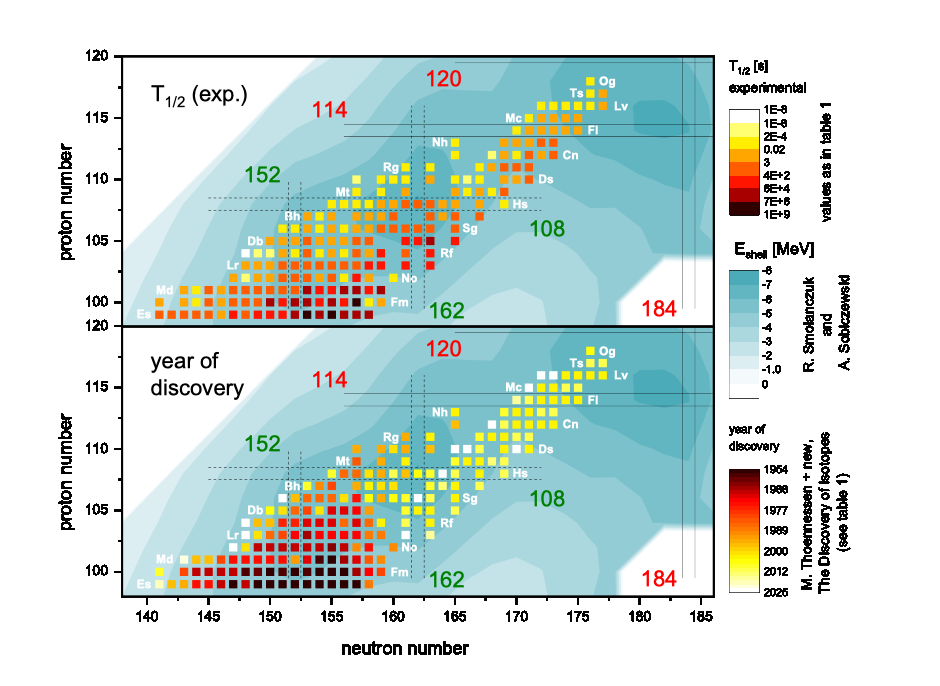
Throughout the decades, a substantial body of data has been accumulated and periodically summarized in review papers that focus on various aspects of the research investigating superheavy nuclei (SHN). Figure 1, as an excerpt of the upper-right part of the chart of nuclides, the Segré chart, illustrates the decay modes of the heaviest nuclei. This review presents a summary of recent achievements employing decay spectroscopy after separation (DSAS; see Fig. 2 for the basic principles of the method) of SHN for all 204 known nuclei of the heaviest 20 elements. The half-lives and years of discovery of these isotopes are shown in Fig. 3 on the background of shell correction energies calculated by Robert Smolanczuk and Adam Sobiczewski (PRC 52 (1995) 1871).
To access the low-lying structure of those heavy species, which have been hitherto almost exclusively produced in fusion-evaporation reactions, DSAS has proven to be a powerful method. The major components involved are a high-intensity beam, an advanced system of targetry, and an efficient separator equipped with a comprehensive particle and photon detection system. The detection technique enables correlations in position and/or time of the recoil implantation and its subsequent decay, due to the inclusive detection of the particles and photons involved.
The scientific background is discussed in the review in terms of various nuclear-structure aspects addressed experimentally, like single-particle levels, nuclear deformation, shell gaps and nuclear isomerism, and decay-mode competition. Regarding theory, two examples of recent progress and their impact on possible further experimental efforts are emphasized: i) The first shell-model calculations for a superheavy nucleus, Dao and Nowacki (arXiv:2409.08210), reproducing the low-lying nuclear structure with astonishing agreement as compared to experimental findings for 254No, promise a possibly deeper understanding of those heavy species; ii) Ravlić and Nazarewicz (PRC 111 (2025) L051305) recently calculated b-decay probabilities of the heaviest nuclei, suggesting that this decay mode is highly competitive up to isotopes of flerovium, while experimental evidence is missing beyond dubnium (see Fig. 1). Revealing b-decay in the region from dubnium to oganesson has the potential to substantially change the decay landscape of this part of the chart of nuclides, which makes this model predictions a clear invitation for experimental efforts in this direction. An ideal place to address this challenge will be GANIL’s new separator-spectrometer set-up S3, presently being installed at the SPIRAL2 LINAC facility.
The main body of the paper reports on new experimental findings, isotope by isotope, from einsteinium to oganesson. The major properties of all isotopes in that region are summarized in a comprehensive table, listing all publications of the relevant experimental efforts, with the aim to provide a comprehensive database as guidance for future experimental efforts.
The search for superheavy elements (SHE) and the investigation of the properties of SHN, throughout the years and decades, always reached a point when progress seemed to come to a halt. A step in technological development and advancement of the experimental toolset, introducing accelerators, detection techniques, and efficient separation methods, often led to a substantial jump in experimental progress, enlarging our understanding of the heaviest nuclei.
For the major working horses, the accelerators, the next-generation high-intensity stable beam facilities are already or will be coming online soon, like the SHE Factory of FLNR JINR (Dubna, Russia) with the new gas-filled separator DGFRS2-2, the linear accelerator RILAC with its upgraded performance in terms of beam intensities at RIKEN (Tokyo, Japan), or the HELIAC project of GSI/FAIR (Germany), which is still in an early stage with the first components being tested.
The next facility in line to actively attack the challenge of SHN research is the SPIRAL2 LINAC at GANIL. The complete capabilities of this installation will become available with the installation of the new injector NEWGAIN. In its final configuration, it will provide the highest intensities for all ions. Together with S3, it will be one of the worldwide most competitive facilities for the investigation of SHN and the search for SHE. Combined with the comprehensive separation and detection installation S3, equipped with the detection array for Spectroscopy and Identification of Rare Isotopes Using S3 (SIRIUS), as well as the S3 Low Energy Branch (S3-LEB) offering tools for the study of fundamental atomic and nuclear properties, it will be ready to advance SHE/SHN research to the next level.
In conclusion, building on the experience of more than a century, with the installations starting operation in these days worldwide, SHE/SHN research faces possibly the next major jump in experimental progress, with the potential to substantially contribute to the fundamental understanding of nuclear matter.
Contact: Dieter Ackermann
The review paper is published in Progr. Part. Nucl. Phys. 147 (2026) 104215; https://doi.org/10.1016/j.ppnp.2025.104215