
Summer School on Physics of Nuclear Open Quantum Systems at GANIL
From July 6 to 24, GANIL hosted the Summer School on Physics of Nuclear Open Quantum System. The School brought together young researchers from around the world with the aim of learning modern theoretical approaches in the field.
The nuclear landscape around the limits of nuclear binding is a fertile ground for research in nuclear structure physics. In addition, astrophysical rapid proton and neutron capture processes operate very close to the drip lines; hence, the structure of very exotic, weakly bound nuclei directly affects how elements are produced in stars. From a theoretical point of view, describing nuclear systems in this regime is a demanding task as it requires understanding of interactions, correlations, and coupling to the continuum of reaction channels. In recent years, significant advances have been achieved, particularly in handling couplings to the continuum—a crucial aspect for describing the weakly bound and unbound states of exotic nuclei. These new methods and theories represent a shift from a traditional description of the atomic nucleus as a closed quantum system to an open-quantum-system formulation, thereby unifying nuclear structure and reactions within a single conceptual framework.
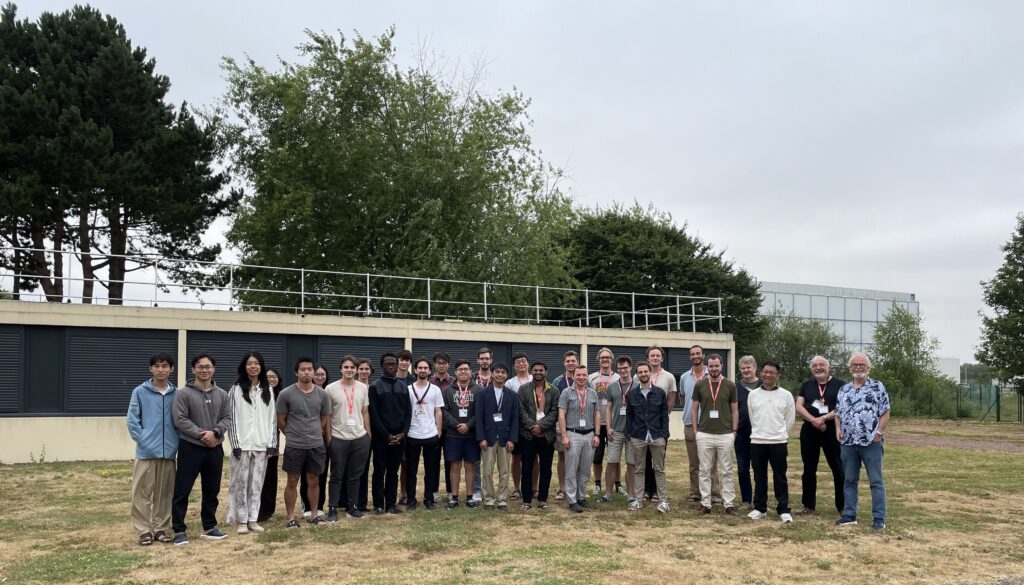
The aim of this Summer School was indeed to give the participants (master’s students, graduate students, and postdoctoral fellows interested in the physics of exotic nuclei) an in-depth understanding of the fundamental concepts of open quantum systems, current developments, challenges, and research opportunities in the specific context of exotic nuclei and nuclear structure near or in the continuum. In addition to lectures, students attended thematic presentations covering a range of exotic phenomena, given by internationally-recognised physicist: Lee Sobotka from Washington University, Marek Pfützner from Warsaw University, Nigel Orr from Laboratoire de Physique Corpusculaire in Caen, Petr Navrátil from TRIUMF, and Andras Kruppa from HUN-REN Institute of Nuclear Research in Debrecen.
The lectures were also complemented by practical sessions with extensive discussion, in which students learned to study the general properties of resonances and the fundamental concepts of scattering theory, progressing from the study of few-body resonances to that of N-body resonances within the framework of the Gamow shell model.
The school was organised by Marek Płoszajczak from GANIL, Kevin Fossez and Alexander Volya from Florida State University, Witek Nazarewicz from the Facility for Rare Isotope Beams at Michigan State University, Simin Wang from Fudan University in Shanghai, and Alain Dassie from GANIL. It was supported by the Normandy Region, the CaeSAR (Caen Strategy for Accelerating Research) initiative, GANIL, NUPECC, the University of Caen Normandie, and the FRIB Theory Alliance. It gathered about 20 participants from several countries in Europe, United States, India, China, and Japan, who also had the opportunity to visit the experimental areas of the GANIL facility.
Contact: Marek Ploszajczak