
FALSTAFF doubles the stakes: first coincident measurements at GANIL
FALSTAFF has set up its summer base at NFS/SPIRAL2 (Neutrons For Science) at GANIL in Caen for the simultaneous measurement of the two fragments resulting from neutron-induced fission of uranium-235. This spectrometer was designed and built by a team of physicists, engineers and technicians from the CEA and IN2P3 (DPhN, GANIL, DEDIP and DIS). Equipped with a single arm until 2025, a second arm was added to FALSTAFF for the recent data-taking campaign this summer. This is therefore the first coincidence measurement for this spectrometer, which is dedicated to the characterisation of fission fragments.
The fission reaction induced by thermal neutrons has been extensively studied over the past 80 years, but data at higher energies are scarce. In the framework of renewed interest in nuclear energy, including fast reactors, fundamental research is essential to improve the accuracy of simulations in order to address the challenges posed by the development of new reactor concepts, sustainable development, safety and waste management, etc. Theoretical fission and de-excitation models, whether phenomenological or microscopic, are also attracting renewed interest. However, their ability to predict fission observables remains limited, and new experimental data are required for their further development. It is within this framework that new upstream experimental programmes have emerged. Thanks, amongst other things, to the NFS/SPIRAL2 facility, these studies can now be extended to the fast-neutron domain.
This is the case with the FALSTAFF spectrometer, which enables the detailed study of fission – a complex mechanism involving deformation effects during the reaction, structural effects, dynamics, and many other phenomena. The new spectrometer measures the velocity and energy of the fragments; these variables make it possible, amongst other things, to reconstruct observables such as the mass of the fragments before and after neutron evaporation, to deduce the multiplicity of the emitted neutrons, and to study the distribution of excitation energy. The pre-evaporation experimental results will be used as input data for the FIFRELIN code, a code dedicated to the de-excitation of fission fragments, developed at CEA/IRESNE. The post-evaporation experimental results will be compared with the predictions of the same code. All the information gathered is also necessary for the creation of nuclear databases used for modelling fast reactors.
The excellent stability of the spectrometer observed during the various measurement periods in the summer of 2026 can be attributed to the intensive work carried out on the full version of FALSTAFF over the past two years. This observed stability paves the way for further experiments at NFS to characterise the fission fragments of other actinides, including uranium-238, plutonium-239, neptunium-237, uranium-233 and thorium-232.
The FALSTAFF spectrometer [1], in its full version with two arms, was installed in the NFS time-of-flight room in April 2026. In Fig. 1, the two arms (blue and pink) are positioned on both sides of the central section, which hosts the uranium-235 target as well as photon detectors.
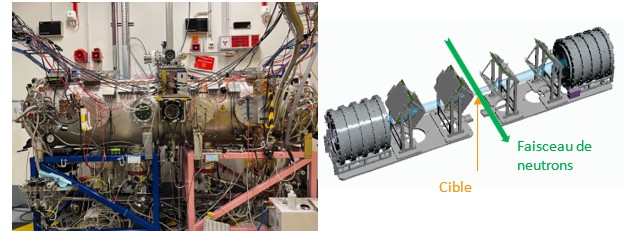
Fig. 1 The two arms of the FALSTAFF spectrometer in the time-of-flight chamber at NFS-SPIRAL2 (left) and a diagram of the detection system (right).
The neutron beam [2], produced by the interaction of a deuteron beam with a thick 9Be target[1], emerges from the collimator embedded in the wall behind FALSTAFF. The very broad neutron energy spectrum thus produced and utilised with FALSTAFF covers energies ranging from a few hundred keV up to 40 MeV, with a maximum intensity of 2 × 10⁶ n/cm²/s at 15 MeV at the FALSTAFF target, situated 5 m from the converter.
The very thin (195 µg/cm²) uranium-235 target, on loan from the JRC-Geel (Belgium), allows the two fission fragments to emerge after the interaction with very little kinetic energy loss. The fragments, emitted back-to-back over 4π, can be detected with a geometric efficiency of approximately 0.35% by identical detection arrays installed in each of the FALSTAFF arms. This low geometric coverage is compensated for by high intrinsic detection efficiency and a high incident neutron flux. Each of these arrays (Fig. 2) consists of two Sed-MWPC[2] detectors [3] for measuring time-of-flight and position in order to determine velocity. An axial ionisation chamber, positioned behind the Sed-MWPCs and in which the fragments are stopped, measures the residual kinetic energy.
Sed-MWPC detectors consist of an emitting foil (0.5 µm of aluminised Mylar, whose composition is similar to that of cling film) from which electrons are knocked out by fragments passing through. These electrons are then directed by an electrostatic field towards a wire-type proportional counter (MWPC). The latter, comprising an anode and a segmented cathode, operates using low-pressure isobutane (6 mbar) and enables position determination with a spatial resolution (standard deviation s) of 2 mm and measurement of the fragments’ transit time of flight between both Sed-MWPC with a temporal resolution (standard deviation s) of ~200 ps. The final component of the apparatus, the axial ionisation chambers, have a, 0.9 µm-thick aluminised Mylar window and are filled with isobutane at 30 mbar. An electric field parallel to the direction of the fragments in the gas is applied, and the signal on the anode is recorded as a function of arrival time with an energy resolution DE/E of 1%. The energy loss profile of the fragments in the gas is thus reconstructed and should enable the nuclear charge of the fragment to be identified.
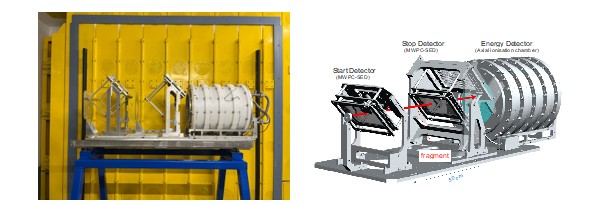
The very high temporal, spatial and energy resolutions achieved are necessary to obtain a good resolution of the pre- and post-evaporation masses for heavy and light fragments and to correctly determine the correlation between the multiplicity of emitted neutrons and the fragment mass. This observable, which is directly linked to the fragment’s excitation energy, contributes to the reaction’s energy balance. This information will enable the refinement of models and is vital for the construction of databases which are subsequently used in simulations of various reactor scenarios.
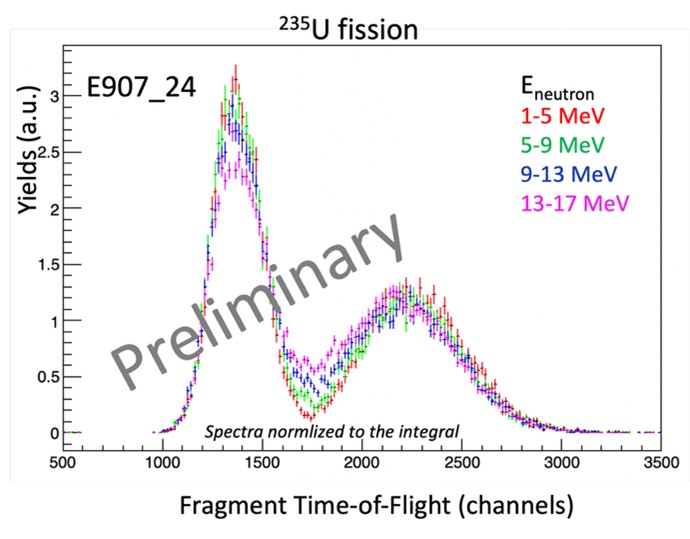
In Fig. 3, a preliminary analysis shows the variation in the time of flight of the fragments between the two Sed-MWPC detectors as a function of the energy of the incident neutrons. The two peaks arise from the asymmetric fission of the nuclear system, when one fragment is heavier and slower to the other, lighter and faster. The trough in-between the peaks relates to symmetric fission, whose probability increases with the incident neutron energy. This expected behaviour is also visible in the energy distributions.
Data collection took place over several weeks spread across June, July and August. Throughout this period, the detector’s response remained stable, which is particularly remarkable for this type of detector. It is largely thanks to the work carried out on the automated control of the vacuum, gas pressures and voltages that FALSTAFF was able to achieve such stability. This success bodes well for future experiments planned at NFS involving other actinides such as uranium-238, plutonium-239, neptunium-237, uranium-233 and thorium-232.
Contacts: Jean-Eric Ducret (GANIL) and Diane Doré (IRFU/DPhN, CEA-Paris-Saclay)
References
[1] First experiment with Falstaff at NFS, January 2023
[2] First converter towers of NFS at Spiral2, July 2018
[3] J. Pancin et al., « A new design of secondary electron detector for low-energy radioactive ion beam », Nuclear Instruments and Methods A1092 (2026) 171816.
Notes
[1] ‘Thick’ here refers to the average free path of a deuton with 40 MeV of kinetic energy in beryllium, which is a few tens of µm.
[2] MWPC : multi-wire proportional chamber.