
Exploring the behavior of nuclear matter through heavy-ion collisions
Nuclear matter is found at the microscopic scale in nuclei, but also on a much larger scale in certain astrophysical scenarios. Understanding the nuclear Equation of State is essential for describing the thermodynamic behavior of nuclear matter, which is in turn a necessary ingredient to model astrophysical objects such as neutron stars and supernovae. A key ingredient of the EoS is its symmetry energy term, which governs how nuclear systems balance protons and neutrons. Constraining its density dependence remains one of the major challenges of nuclear physics, with important consequences in astrophysics, e.g. for the modelization of neutron stars and the interpretation of gravitational wave signals.
This experiment, carried out in GANIL in 2019, investigated 58,64Ni+64,58Ni collisions at 32MeV/nucleon using INDRA-FAZIA, the most advanced apparatus for measuring the neutron-proton composition of the products of heavy-ion collisions in the Fermi energy domain.
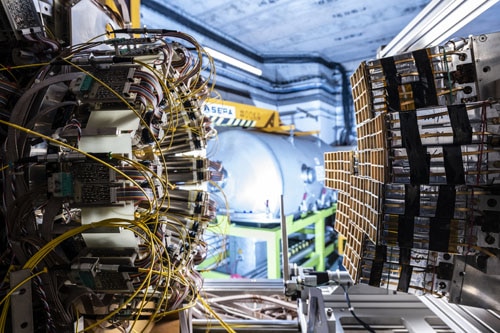
Thanks to FAZIA’s state-of-the-art isotopic resolution, the neutron-to-proton ratio of the quasiprojectile remnants has been directly measured, providing a robust probe of isospin diffusion. A model independent reconstruction of the impact parameter has been implemented based on the information collected by INDRA. The gradual equilibration of the initial isospin imbalance has been observed by comparing the quasiprojectile remnants produced in the two opposite asymmetric reactions (64Ni+58Ni and 58Ni+64Ni). For increasingly central collisions, these remnants become progressively more similar to each other. This can be visually understood from the plot here below, providing the most precise evidence of isospin diffusion to date, where the graphs for the two reactions tend towards each other as the impact parameter b decreases (i.e. for more central collisions).
The result has been published in Phys. Rev. C: https://doi.org/10.1103/PhysRevC.111.044601
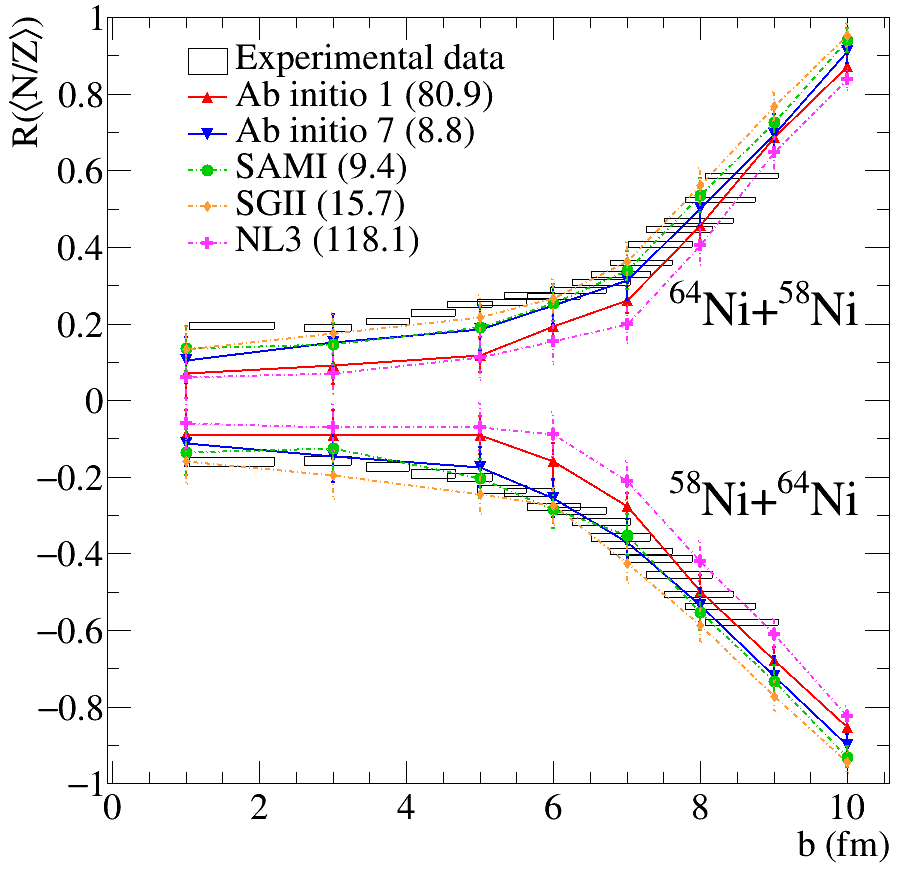
Thanks to a collaboration with LPC Caen and the VECC (Kolkata, India), supported by the GANIL Visiting Scientist program, the experimental result has been compared to BUU@VECC-McGill transport model simulations, employing both ab-initio and phenomenological nuclear interactions. A consistent study of the time evolution of the baryonic densities and the neutron and proton currents allowed to precisely determine the density region effectively probed in this experiment, to avoid uncontrolled extrapolations.
The comparison with transport-model calculations shows that the experimental trend cannot be reproduced by very “stiff” parametrizations of the symmetry energy, i.e. those predicting a rapid increase of the symmetry energy with density. In contrast, the data are better described by “soft” parametrizations, where the increase with density is more moderate. The results are in line with the softer side of ab-initio predictions. Our full analysis, including the study of the sensitive density region, yielded the definition of confidence areas in the symmetry energy vs density plane around saturation density, providing one of the most stringent experimental constraints to date.
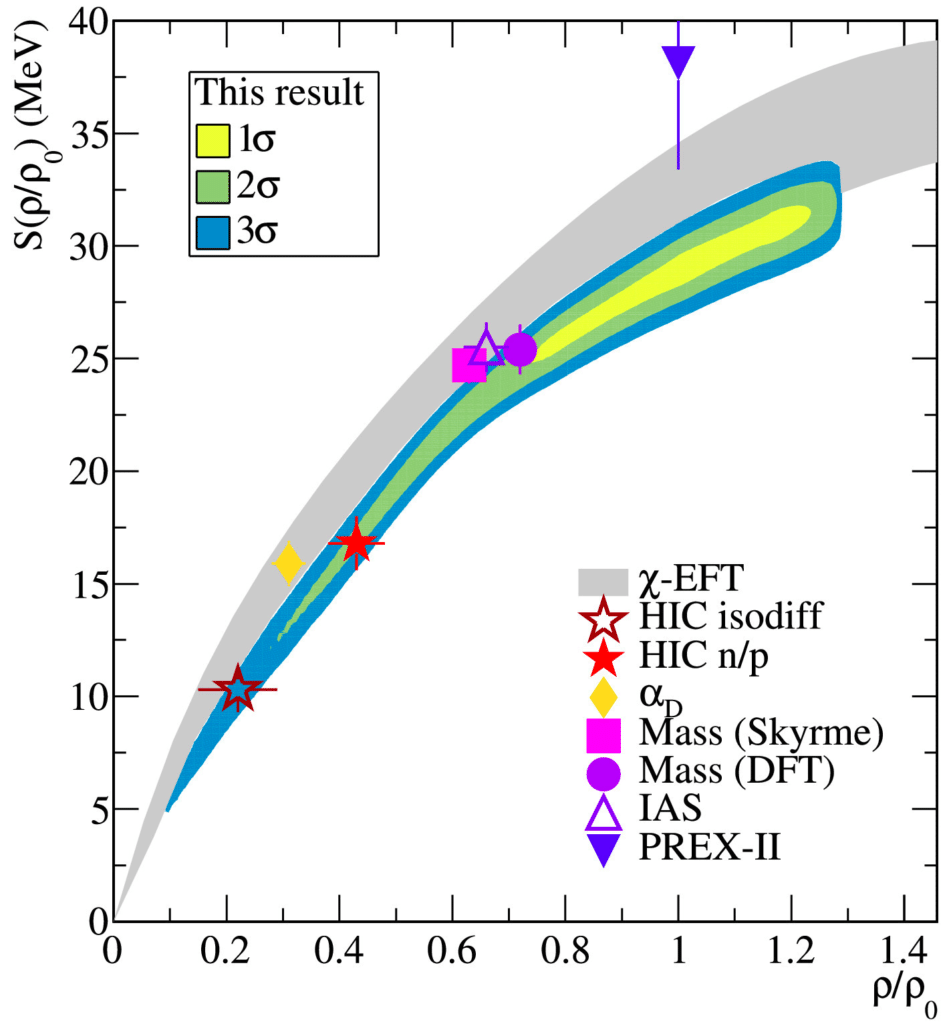
This constraint, complementary to those coming from astrophysical observations, can be directly used for the inference of the nuclear EoS of neutron stars.
The result has been recently published in the journal Phys. Lett. B: https://doi.org/10.1016/j.physletb.2025.139815
Contact: Caterina Ciampi