PHASE
The PHASE (Physics of HeAvy and Superheavy nuclEi) group is composed of 5 researchers from GANIL and 3 associate researchers (2 from IJCLab & 1 from LPC Caen), and a number of postdocs and PhD students, working on nuclear structure, reaction mechanism and ground state properties of heavy and superheavy nuclei as well as lighter n-rich isotopes in the vicinity of 100Sn, using different instruments.
The group activities can be broadly characterized into three main activities:
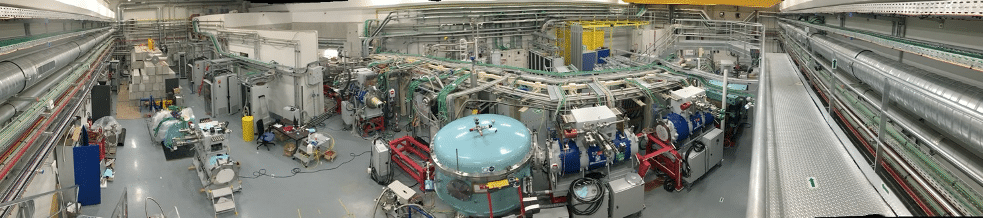
- The study of transactinide and superheavy nuclei. This activity primarily focuses on the construction, preparation of operation and, in the near future, exploitation of the Super Separator Spectrometer (S3). These will include:
- Investigation of nuclear structure by means of decay spectroscopy after separation (single particle trends, isomeric states, decay-mode competition)
- Reaction mechanism features (fusion probabilities and competing channels) for superheavy nuclei (including possibly the synthesis of (new) superheavy elements).
- Ground state properties of the heaviest nuclei (hyperfine structure, mean charge radius, mass).
This program will use the two S3 focal plane installations
-
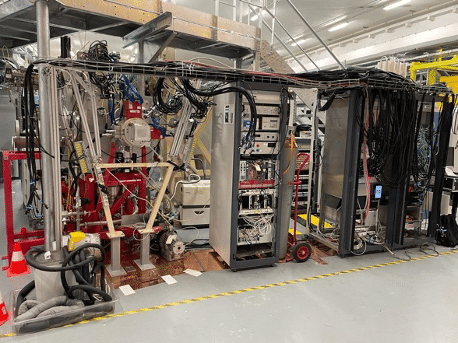
- SIRIUS (System for the Identification of Rare Ions Using S3) decay station for the spectroscopy of the excited states
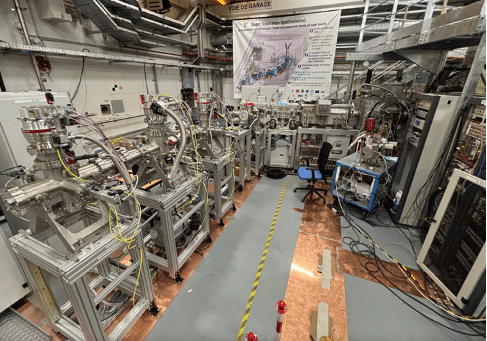
- S3 Low Energy Branch (S3-LEB) for the study of ground state properties.
Laser Resonance Chromatography (LRC) has been initiated to study atomic structure properties of heavy species and their metastable states via their ion mobility.
Currently, these studies are mainly pursued in international collaborations with Argonne National Laboratory (AGFA, FMA, Gammasphere & GRETINA), GSI-FAIR (SHIP & TASCA), JYFL (RITU), and LNL/INFN (PRISMA & AGATA).
- The investigation of N=Z nuclei around 100Sn using S3-LEB is also planned. Studies of the properties of nuclei close to the doubly-magic 100Sn such as variation of the mean charge radius, mass or hyperfine structure. This activity is also pursued at JYFL using the IGISOL beamline.
- The investigation of the nuclear structure of heavy nuclei produced using induced fission or multinucleon transfer and the associated reaction mechanism has been started recently or will be pursued in the near future, employing the magnetic spectrometers VAMOS++ of GANIL and PRISMA of LNL.