
FAZIA
Presentation
FAZIA is a step towards the goal of a next generation 4π detector array for heavy-ion collisions with greatly enhanced isotopic identification capabilities. The determination of the charge and mass of all reaction products in multi-body, highly-dissipative reactions is essential to advance knowledge of topics such as the density dependence of nuclear symmetry energy, in-medium isovector transport properties of nuclear matter, and EoS modification due to clustering at very low densities.
An international collaboration is responsible for the development and maintenance of FAZIA detection systems, the scientific programmes using them in heavy-ion collision experiments around the world, and exploiting the resulting data. For more details, including links to recent publications, see the FAZIA collaboration website.
|
|
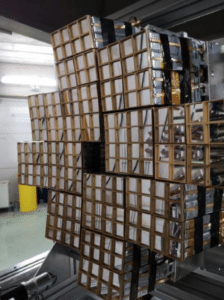
Description
FAZIA is a modular array comprised of 1 or more blocks of 16 detection telescopes assembled in a square 4×4 array (see Figure 1). Each of these is the result of more than 10 years of R&D into pushing the limits of the ΔE-E technique with highly uniform (in thickness and doping) silicon detectors, refining Pulse-Shape Analysis (PSA) techniques for identification in a single detector, and developing a dedicated on-board electronics comprising both analogue (pre-amplifier) and digital stages.
Each telescope is composed of 3 detectors placed one behind the other: first a ‘thin’ silicon detector (typically 300 µm thick), then a ‘thick’ silicon (500 or 750 µm thick), and finally a 10 cm long CsI scintillator detector read out by photodiode. Just behind the 16 telescopes which make up a FAZIA block are all the electronics dedicated to the biasing, readout and digital signal processing of the 48 independent detectors, housed in a 50x10x10 cm ‘sarcophagus’ metal box comprising a copper plate in which cooling water is circulated during operation under vacuum.
Each block has only 3 external connectors: a 48 V power supply cable, and a pair of fibre optic connectors, which connect it to the Regional Board, a VME-format central unit which is outside the vacuum chamber. The Regional Board is responsible for slow control communications with all blocks/detectors, and readout of all triggered detectors during data acquisition.
“The FAZIA Project in Europe: R&D phase”, R. Bougault et al, Eur. Phys. J. A (2014) 50:47 https://doi.org/10.1140/epja/i2014-14047-4
“The FAZIA setup: A review on the electronics and the mechanical mounting”, S. Valdré et al, Nuclear Inst. and Methods in Physics Research, A 930 (2019) 27–36 https://doi.org/10.1016/j.nima.2019.03.082
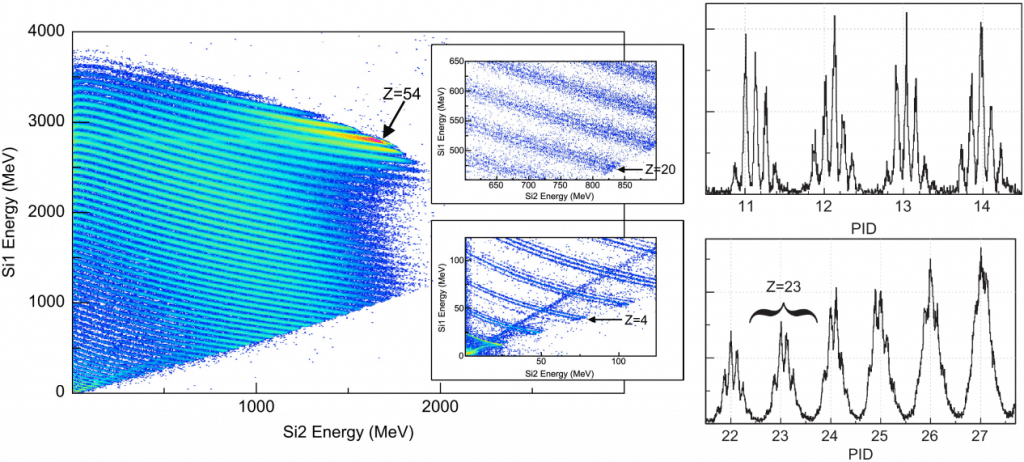
Figure 2: FAZIA identification capabilities for particles punching through the first 300µm-thick Si detector: (left) DE-E matrix for reactions with Xe projectiles; (right) PID (particle identification number) spectra showing resolved mass peaks for different Z values.
Performances
The mass and charge identification performance of FAZIA telescopes is exceptional and unique (see Figure 2): for fragments punching through the first silicon detector, isotopic resolution is achieved up to Z=25, while the Z & A of slower fragments stopping in the first silicon can also be obtained, up to Z=20. All heavier fragments can be identified in Z. High energy light charged particles can be stopped and identified in the CsI detector (up to ~190 MeV protons).
Recent Experiments (coupled with INDRA)
Since 2019, 12 blocks of FAZIA are in use as part of the coupled INDRA-FAZIA array (see Figure 1). In this configuration, the 5 most forward rings (θ<14°) of INDRA have been removed and replaced by a wall of FAZIA blocks. The following experiments were all performed with this setup.
https://data.ganil-spiral2.eu/record/10.26143/ganil-2019-e789_18
https://data.ganil-spiral2.eu/record/10.26143/ganil-2022-e818_20
https://data.ganil-spiral2.eu/record/10.26143/ganil-2025-e884_23
https://data.ganil-spiral2.eu/record/10.26143/ganil-2025-e881_23
Contacts
FAZIA Collaboration website: https://fazia.in2p3.fr
Scientific coordinator: Nicolas Le Neindre, LPC Caen leneindre@lpccaen.in2p3.fr
GANIL contact: John Frankland john.frankland@ganil.fr