
INDRA
Presentation
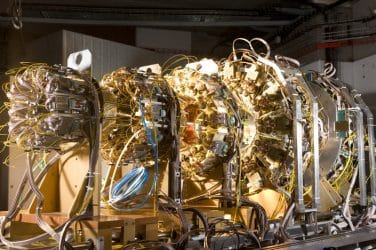
INDRA (“Identification de Noyaux et Détection avec Résolutions Accrues”) is a 4π charged particle multidetector specifically designed to efficiently measure and reconstruct multi-body exit channels of heavy ion reactions in the energy range of the GANIL cyclotrons. Conceived (using computer-aided design, for the first time in nuclear physics) and built by a collaboration of French CNRS and CEA laboratories including GANIL at the end of the 1980s, INDRA has been in constant use since 1993.
Description
a. Overview of array geometry and detectors
The basic design of INDRA is 336 independent detection modules covering laboratory polar angles (θ) from 2° to 88° and 92° to 176°. The modules (‘telescopes’ made of several detection layers of different types) are grouped into 17 axially-symmetric ‘rings’ containing 8, 12, 16 or 24 telescopes, depending on θ. Each telescope is oriented in the direction of the target, placed at the centre of the array. INDRA can be thought of as being split into a ‘forward’ part, consisting of all rings which are downstream of the target holder (θ<90°), and a ‘backward’ part placed ‘behind’ the target, with respect to the beam direction, at angles θ>90°.
The ‘last’ (=furthest from the target) layers of all INDRA telescopes are CsI(Tl) scintillator detectors of varying length (along the telescope’s axis), between ~5 and ~14 cm. The longest of these, placed at the most ‘forward’ angles (small θ), can stop protons with energies up to 235 MeV. On rings 1 to 9, covering angles up to θ=45°, the next-to-last layer is a Silicon semiconductor detector, with a typical thickness of 300 µm (sometimes 150 µm for specific experiments). From 1993 until 2011, the first detection layer of each module on rings 2 to 17 of INDRA was a 5 cm-thick ionization chamber operated with C3F8 gas at low pressures (20~50 mbar), keeping identification thresholds for heavy fragments low (~1 MeV/u). They have been abandoned as it is no longer feasible to maintain them.
Since 2019, INDRA is used as part of the INDRA-FAZIA array in D5. In this configuration, the 5 most forward rings (θ<14°) of INDRA have been removed and replaced by 12 FAZIA modules. INDRA is currently composed of 240 CsI detectors, of which 96 (rings 6-9: 14°<θ<45°) are preceded by a 300 µm Silicon detector.
“INDRA, a 4π charged product detection array at GANIL”, J. Pouthas et al., Nuclear Instruments and Methods in Physics Research A357, 418 (1995) https://doi.org/10.1016/0168-9002(94)01543-0
b. Electronics and data acquisition
Inside the vacuum chamber, the charge pre-amplifiers for silicon detectors and (when in use) ionization chambers are mounted on custom-made mother boards directly connected to the detector frames. The scintillation light produced in CsI detectors is read out by photomultiplier tubes with specially-designed transistorized bases, in order to reduce power consumption for vacuum operation. The output signals from all detectors (and also the low and high voltage bias lines) are cabled through air-vacuum feed-throughs under the vacuum chamber, from where they are transported to an air-conditioned cabinet containing the data acquisition electronics and voltage supplies.
INDRA is equipped with commercial digital electronics provided by mesytec GmbH & Co. KG. Specifically, 32-channel MDPP digitizers with different firmwares are used for both Silicon and CsI detector signals, SCP (Standard Charge Pre-amplifier) firmware for the former, and QDC firmware for the latter: the CsI light signal is integrated with two different timescales, a ‘fast’ signal corresponding to 400 ns and a ‘total’ signal integrated over 3 µs. An MVLC module is used for triggering and event readout. Each detector can trigger independently; the trigger signals from all MDPP modules are used by the MVLC to accept or reject an ‘event’; if an event is accepted, all triggered channels occurring within a pre-defined coincidence window are validated and read out.
Since an upgrade of the MDPP firmware in 2025, the signal waveforms for triggered detectors can also be acquired: they are used in order to calculate the rise-time of the Silicon detector signals, permitting the identification of low-energy nuclear fragments which do not punch through to the CsI, without the need for ionization chambers.
“Digital electronics upgrade of the INDRA 4π charged particle detection array and resulting performance improvements”, J. D. Frankland et al., Nuclear Instruments and Methods in Physics Research A 1082 (2026) 170908 https://doi.org/10.1016/j.nima.2025.170908
c. Performances
In its current incarnation, equipped with digital electronics and coupled with FAZIA, the experiments performed with the INDRA-FAZIA array have focussed on beams of 12C, 36,40Ar, and 70Zn. The heaviest fragments reaching the most forward ring 6 at θ~17° in these reactions have Z~20-23, and unit charge identification is achieved for all those which punch through the Silicon detectors on rings 6-9. In addition, for these fragments isotopic (A) identification is also achieved, up to Z~10, when statistics are sufficient. The lightest nuclei, up to Z=4, can be isotopically identified by correlating the ‘fast’ and ‘total’ light signals from the CsI detector: up to 45° this is used solely for identification of high-energy H isotopes (which do not trigger the Silicon detector), whereas for θ>45° this is the only identification possibility available for any nuclei.
Fragments stopping in Silicon detectors at angles θ≤45° can be identified in both Z and A, with low thresholds (~3 MeV/u for 12C ions). Z identification is achieved at least up to Z=9. So far (2026), only one experiment has been performed with this capability, using 12C beams on 12C targets, therefore it remains to be seen how far this can be extended.
Another recent development this year has been the first use of the 240 CsI detectors’ capabilities for gamma detection: although resolution is not very high, the array constitutes a high-efficiency calorimeter for gamma rays, and it is possible to identify individual decays for specific selected reaction channels in, for example, direct reactions at beam energies ~10 MeV/u.
Recent Experiments (coupled with FAZIA)
https://data.ganil-spiral2.eu/record/10.26143/ganil-2019-e789_18
https://data.ganil-spiral2.eu/record/10.26143/ganil-2022-e818_20
https://data.ganil-spiral2.eu/record/10.26143/ganil-2025-e884_23
https://data.ganil-spiral2.eu/record/10.26143/ganil-2025-e881_23
Contacts
Scientific coordinator: Nicolas Le Neindre, LPC Caen (leneindre@lpccaen.in2p3.fr)
GANIL contact: John Frankland (john.frankland@ganil.fr)