
Vibrations as a Window into Nuclear Shape and Structure
Atomic nuclei can vibrate in surprisingly ordered ways. Even when they’re messy, vibrations played a central role in revealing nature’s fundamental laws, from the swing of a pendulum to the vibrations of atoms in a crystal, to gravitational waves. In this work, a particularly complex type of nucleus, having both an unpaired proton and an unpaired neutron, where orderly collective motion is usually hidden by chaotic individual particle behavior, was characterized. Under an international collaborative effort, data from advanced high-efficiency devices of VAMOS++ coupled to AGATA and EXOGAM spectrometers at GANIL, and the Gammasphere detector array in the USA, are combined to understand the vibrations of the neutron-rich nucleus Niobium-104 . A clear evidence of simple and more complex vibrational patterns, as well as indications that the nucleus can adopt multiple shapes at nearly the same energy were observed. This result shows that, even in very complicated nuclear systems, surprisingly coherent and well-organized motion can survive, offering new insights into how matter behaves at its most fundamental level and a better understanding of complex quantum systems.
In atomic nuclei, nucleons (protons and neutrons, that are fermions) are bound together by strong forces at a very small length scale. The nucleons can move in various orbitals, referred to as single-particle motion, or can be collectively moving in a correlated manner. In the extreme case of the latter, a nucleus can be treated as a rigid rotor, in analogy with molecules. Nuclear vibrational phonons represent the collective motion of protons and neutrons and vibrations can take even more exotic form, such as large amplitude vibrations corresponding to resonance states in the continuum; some of these can be visualized as the vibration of neutron versus proton fluid or even to compression modes. Such vibrational states generally require a large excitation energy of the nucleus.
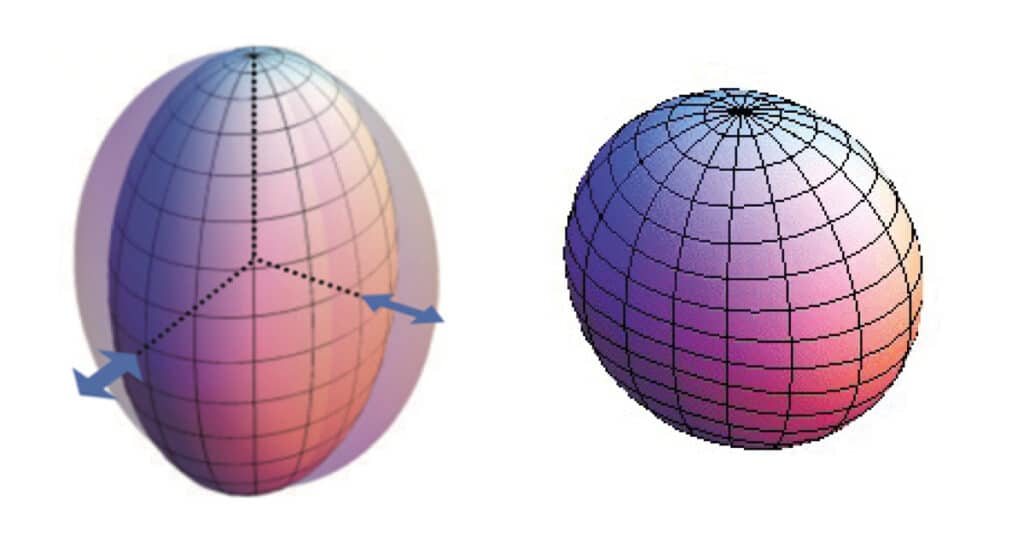
Low-energy nuclear vibrations are successfully described by Bohr and Mottelson more than half a century ago, using a collective model that treats the nucleus like a quantum liquid drop. In this picture, nuclear-shape vibrations are described by parameters that measure how much the nucleus departs from a sphere and whether it maintains symmetry around an axis or adopts a more asymmetric, triaxial shape with no axis of symmetry (like a squashed ellipsoid). Among these, quadrupole vibrations in deformed nuclei can be classified as β and γ vibrations. The gamma (γ) vibration can be considered as vibration away from axial symmetry while roughly keeping its overall deformation.
Vibrations in nuclei are fundamentally different from extended systems such as crystals, in which phonons are nearly perfect bosons— the system is harmonic, and many phonons can occupy the same vibrational mode without restriction. On the other hand, nuclei are composed of fermions. Nuclear phonons arise from coherent superpositions of particle–hole excitations and only approximately obey bosonic statistics. The Pauli principle limits the fermionic excitations participating coherently, thereby restricting the number of multi-phonon excitations. Furthermore, nuclear vibrations are anharmonic, which reflects the strong coupling between collective motion and non-collective individual nucleon degrees of freedom. As a result, the number of phonons in nuclei, and especially in odd-odd nuclear systems (that is, nuclei containing both an odd (unpaired) proton and neutron) is limited.
Experiments to study the structure of odd-odd nuclei are much more challenging compared to even-even nuclei. In these systems, low-energy states are usually dominated by complex combinations of individual particle motions. Therefore, the presence of many excited states makes it extremely difficult to identify clear vibrational patterns from their properties. This makes them especially valuable: when observed, they provide stringent tests of nuclear-structure models and insight into how collective motion competes with individual particle behavior. No evidence for the vibrations of a triaxial nucleus has been found so far in odd-odd nuclei.
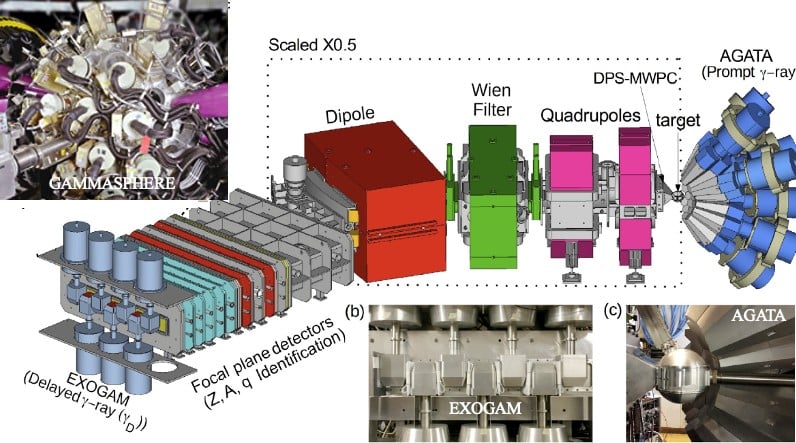
The nucleus of interest, the neutron-rich nucleus 10441Nb63 (note that 93Nb is the only stable isotope existing on the earth) was produced in a nuclear fission reaction where a large number of fragments are produced in various discrete quantum excited states. To identify the excited states of a single nucleus is like searching for a needle in a haystack. This challenging measurement was only possible due to the combination of two state-of-the-art complementary γ-ray spectroscopic measurements of the excited states through their gamma decay. The magnetic spectrometer (VAMOS++) with isotopic resolution coupled to a γ-ray tracking array AGATA (when it was at GANIL), together with the EXOGAM array, were used to identify the excited states of the fission fragments produced in reactions of 238U beam with 9Be target. The Gammasphere array (when it was at LBL, USA) was used to independently obtain high-fold γ-coincidence measurements employing a 252Cf source. The isotopic identification along with new states in 104Nb achieved at GANIL was then used to generate high-fold gamma coincidence events, obtained from the spontaneous fission of a 252Cf source, placed at the center of the Gammasphere array at LBL (USA), to develop a complete excited level structure. This joint effort also shows how international collaborations using open data can address problems otherwise not possible to tackle. In the neutron-rich nucleus ¹⁰⁴Nb, bands of excited states corresponding to one- and two-phonon γ vibrations were identified using known theoretical relations, for example, energies and strengths of electromagnetic transitions. Measurements of angular correlations allowed to establish the spins and parities of the observed states.
The properties of the observed bands—such as their similar moments of inertia, magnetic characteristics, and strong interconnecting transitions between them—showed that they share a common vibrational origin. These experimental results were also well reproduced by advanced theoretical shell-model calculations that account for triaxial nuclear shapes. In addition, the measurement of the presence of a uncharacteristic lifetime suggests the coexistence of different nuclear shapes, including a long-lived oblate configuration, within the same nucleus. These multiple shapes are an example of shape coexistence, also seen in many other nuclei,corresponding to different arrangements of nucleons. The fact that they coexist indicates near-degeneracy of different energy minima in the nuclear potential. Essentially, the nucleus can “choose” multiple shapes at almost the same energy.
This work demonstrates that collective vibrational motion can remain surprisingly robust even in the presence of unpaired protons and neutrons, and that multiple nuclear shapes may coexist in a single system. Discovering more examples of multi-phonon vibrations in odd-odd nuclei will deepen our understanding of how individual nucleons influence the collective motion, depending on which orbitals they occupy. Beyond nuclear physics, such insights may help to better understand the nature of vibrations in complex quantum systems across various areas of physics.
These results have been recently published in E. Wang et al., Phys. Rev. Lett. 136, 072501 (2026); https://doi.org/10.1103/1gy6-v3sb.
Contact: Navin Alahari